
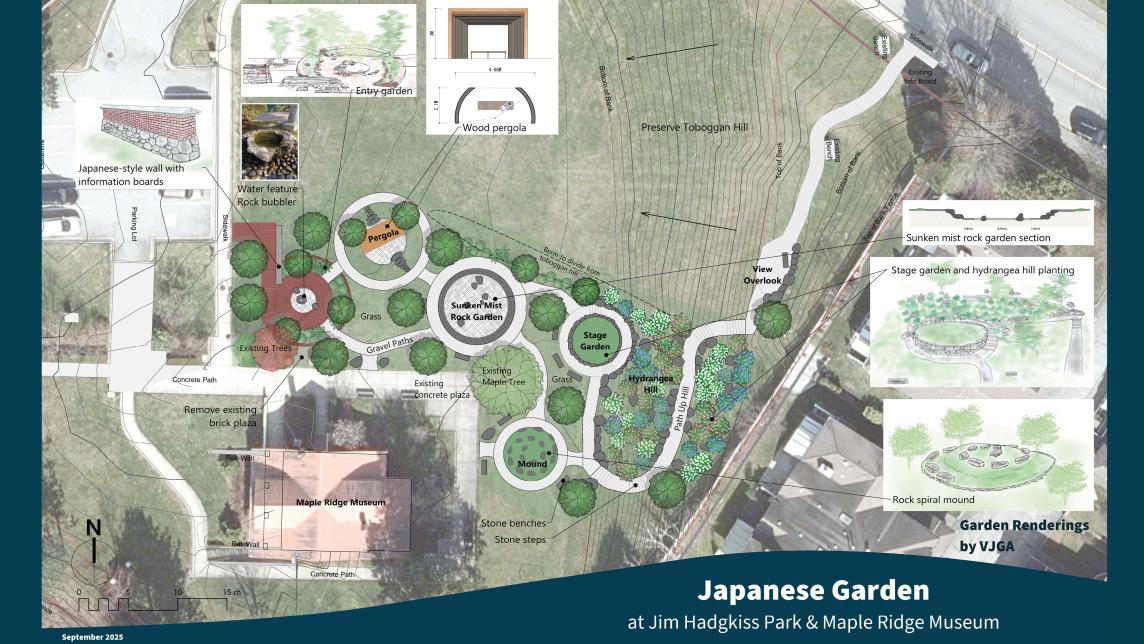
MAPLE RIDGE, BC – April 13, 2026 – Construction on the new Japanese Garden at Jim Hadgkiss Park has now started, marking an important milestone in a project that will honour the legacy and contributions of early Japanese Canadian families who settled in Maple Ridge in the early 1900s and helped shape the community’s agricultural roots along the Fraser River.
Funded by the Japanese Canadian Legacies Society (JCLS) and designed through community engagement and in collaboration with the Vancouver Japanese Gardeners' Association (VJGA), the garden will be located near the Maple Ridge Museum and serve as a place of reflection, remembrance, and learning.
Construction and Public Access
During construction, Jim Hadgkiss Park and the Maple Ridge Museum will remain open during normal operating hours.
The accessible parking stall and the west side of the parking lot will remain open, parking on the east side of the lot may be temporarily closed for construction access and staging.
Community Engagement
Residents and community members were invited to share feedback on the proposed design concept in summer 2025. Based on the feedback, several updates were made to refine the final design, including:
- shifting the garden south to retain more of the toboggan hill;
- adding a small planted linear berm between the garden and toboggan hill to help protect the garden;
- adding a water feature to the entrance garden plaza;
- incorporating strawberries as groundcover in the planted area and on the rock spiral mound; and
- including interpretive information boards that highlight the history of local Japanese Canadian settlement, community, farming, and internment during the war.
A Garden Rooted in History and Reflection
The Japanese garden is envisioned to be a peaceful, reflective stroll garden that recognizes a place of significance in Maple Ridge and promotes public awareness of pre-war and wartime Japanese Canadian history.
The garden design concept is rooted in the Japanese phrase “Ichi-go, Ichi-e,” meaning to treasure a once-in-a-lifetime encounter. The design includes traditional elements such as a sunken mist rock garden, water bowl, pergola shelter, and a stone-and-brick wall. Local trees, plants, and natural materials will also reflect the surrounding environment and the historical significance of the site, including the legacy of the Port Haney Brick and Tile Company.
The location of the garden complements the Maple Ridge Museum’s exhibit on early Japanese Canadian settlement and the treatment of Japanese Canadians in Maple Ridge. In the early 20th century, Japanese Canadians represented a significant part of the local population, with many families farming strawberries and other crops before their internment during the Second World War.
To learn more about the project, including a summary of the engagement results, and to sign up to receive project updates, visit Engage.MapleRidge.ca/JapaneseGarden.
- 30 -
Media Contact
Pardeep Purewal, Senior Manager Corporate Communications and Public Engagement
T 604 466 4319 C 778 955 4249
E Media@MapleRidge.ca